Content Repurposing for Social Media Services in India
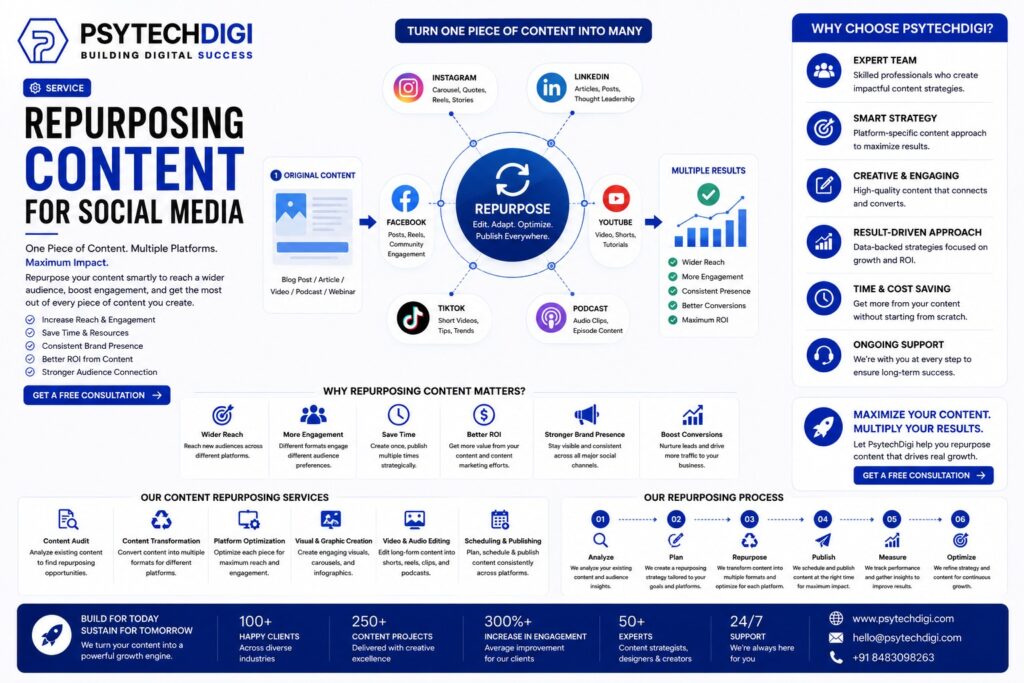
Your best content deserves a longer life than a single publish cycle can give it. Most businesses spend hours crafting a strong blog post or recording a detailed video, share it once, and then move on — leaving the bulk of its potential reach permanently untapped. Repurposing Content For Social Media is the strategy that fixes this. By taking existing material and transforming it into formats suited to each platform, brands generate consistent, high-quality social presence without a proportional increase in time or budget. This article explains how it works, why it outperforms constant new content creation, and how Psytech Digi Pvt Ltd makes it happen for your business.
Why Creating New Content Every Day Is Not the Answer
The pressure to post consistently across Instagram, LinkedIn, YouTube, Facebook, and Twitter can feel relentless. Many businesses respond by producing more content — more articles, more videos, more posts — until the team burns out and quality drops. This is a volume trap, and it is one of the most common and costly mistakes in digital marketing today.
The solution is not more content. It is smarter use of the content you already have. A single well-researched blog post contains enough raw material to fuel a full month of social media posts across multiple platforms. The insights are there. The research is done. The expertise is already expressed. What is missing is the deliberate process of reshaping that material for each channel and audience.
The Compounding Value of Existing Content
Every piece of evergreen content — guides, tutorials, case studies, data reports — has a shelf life far longer than one publish cycle. When these assets are systematically broken apart, reformatted, and redistributed across social channels, they continue generating impressions, engagement, and brand awareness for months. This compounding effect is what makes content repurposing one of the highest-return activities in a content marketing programme.
Repurposing Content For Social Media: Core Formats That Perform
The practical backbone of Repurposing Content For Social Media is knowing which source format transforms well into which social format. Not every transformation works equally well on every platform. Understanding these pairings is what separates a structured repurposing strategy from random cross-posting.
Blog Posts to Social Carousels
Why carousels work
A long-form article typically contains eight to twelve distinct insights. Each of these becomes a single carousel slide on LinkedIn or Instagram. Carousel posts earn strong algorithmic favour on both platforms because swipe behaviour signals active engagement — and both platforms reward that signal with wider distribution. The best carousels take the most counterintuitive or immediately useful point from each section of the article and make it visually self-contained.
Long-Form Video to Short Clips
Extracting the moments that stand alone
A 45-minute webinar or product demo contains dozens of standalone moments — each a complete idea that needs no surrounding context to land. Trimmed to 30–90 seconds, captioned, and optimised for vertical format, these clips are ready for Instagram Reels, YouTube Shorts, and TikTok. Each clip targets a different search intent and reaches audience members who would never have watched the full-length original.
Podcasts and Interviews to Written Articles
Audio content has SEO potential
Podcast episodes, interviews, and recorded conversations can be transcribed and edited into structured blog articles. Key quotes become pull quotes for Twitter or LinkedIn. Statistics mentioned in passing become data graphics for Instagram. A single episode can yield a written article, three to five social posts, and a short video highlight clip — all from content already produced.
Research and Data to Infographics
Data-rich content — surveys, industry reports, case studies — compresses naturally into infographic format. Infographics are among the most widely shared content types on social media because they make complex information immediately digestible. A well-designed infographic from an existing report can earn organic shares, backlinks, and brand impressions long after the original document was published.
Tailoring Content to Each Platform’s Native Behaviour
The most common mistake in content distribution is treating all platforms as identical outputs. Effective Repurposing Content For Social Media requires adapting not just the format but the tone, length, caption style, visual dimension, and call-to-action for each specific channel.
LinkedIn: Analytical, Professional, Insight-Driven
LinkedIn rewards depth. Long-form text posts that share a specific lesson, a counterintuitive finding, or a data-backed perspective consistently outperform generic announcements. Native carousels uploaded as PDFs directly to the platform outperform external links. Content that speaks directly to professional challenges — how to solve a problem, what a result looked like, what went wrong and why — earns both engagement and credibility.
Instagram: Visual, Immediate, and Emotion-Led
Instagram is a scroll-stopping platform. The first frame of a Reel or the first slide of a carousel must earn attention within two seconds or lose it permanently. Content that teaches something specific and immediately applicable — a quick tip, a surprising comparison, a before-and-after result — earns saves, which Instagram’s algorithm treats as its highest-quality engagement signal and rewards with expanded reach.
YouTube Shorts and TikTok: Hook First, Context Second
Short-form video platforms invert conventional content structure. Instead of setting context before delivering value, the most interesting or unexpected moment must come first — within the first two to three seconds. Repurposed clips need to be re-edited with this requirement in mind, not simply trimmed from a longer video. On-screen text and captions are equally important, since a significant portion of viewers watch with sound off.
Building a Repurposing System That Scales
The businesses that benefit most from content repurposing are not those who attempt it occasionally — they are those who operate it as a structured, repeatable system. A systematic approach turns repurposing from a creative task into a reliable production process.
Start With a Content Audit
The first step is identifying your highest-value existing assets. Not all content repurposes equally well. Evergreen pieces — those that address questions or problems that remain relevant over time — offer the greatest repurposing potential. High-performing historical posts, detailed how-to guides, and data-rich reports are typically the richest sources. A content audit maps these assets, identifies their repurposing potential, and prioritises which to transform first.
What makes a strong repurposing candidate
- High historical traffic or engagement on the original platform
- Evergreen topic that does not lose relevance over time
- Clear structure with multiple distinct sections or points
- Data, statistics, or specific examples that work as standalone social assets
Integrate Into a Content Calendar
Repurposed assets should flow directly into a content calendar that maps each piece to its platform, format, and scheduled publish date. This prevents duplication across channels, ensures consistent pacing, and allows the same core topic to appear across multiple platforms over two to three weeks without the audience experiencing it as repetitive. A blog post published Monday becomes a LinkedIn carousel Wednesday, an Instagram Reel Friday, and a Twitter thread the following Tuesday.
How Psytech Digi Pvt Ltd Grows Your Social Presence Through Content
Psytech Digi Pvt Ltd is a Pune-based digital marketing and software development agency with active clients in India, the United Kingdom, Australia, and Indonesia. The content team combines strategic thinking, design capability, and platform expertise to deliver repurposing programmes that are both systematic and creatively strong — producing material that feels native to each platform, not recycled from somewhere else.
The Psytech Digi Approach to Repurposing Content For Social Media
Psytech Digi’s approach to Repurposing Content For Social Media is built around a five-step process designed to extract maximum value from your existing content library while maintaining consistent brand quality across every output and every channel.
Step 1 — Content Audit and Asset Mapping
Step 2 — Platform Strategy and Format Planning
Step 3 — Content Transformation and Production
Step 4 — Brand Consistency Review
Step 5 — Performance Tracking and Programme Improvement
Psytech Digi’s clients consistently highlight the team’s reliability, communication quality, and on-time delivery — qualities that matter especially in content work, where publishing calendars depend on consistent, predictable output.
Make Every Piece of Content Work Harder
You have already done the hard work. The research is complete, the expertise is written down, the ideas are captured. The question is whether that value sits in a single published post or gets deployed across every platform your audience uses.
Repurposing Content For Social Media is the strategy that turns one strong piece into a month of consistent brand presence—without adding proportionally to your content budget or your team’s workload. It builds audience reach through repetition in different formats, meets buyers at every stage of their decision-making journey, and makes the most of every hour your business invests in creating content.
Psytech Digi Pvt Ltd is ready to audit your existing content, build your repurposing roadmap, and handle the transformation and production from start to finish. Reach out today to find out how much more your current content library can do.
What is content repurposing for social media?
Content repurposing is the process of taking existing material — a blog post, video, podcast, or report — and transforming it into different formats suited to each social platform. One strong blog post can become a LinkedIn carousel, an Instagram Reel, a Twitter thread, and an infographic — reaching a much wider audience without creating new content from scratch.
How many social media posts can one blog post generate?
A well-structured blog post with 8 to 12 distinct insights can typically generate 4 to 6 weeks of social media content across multiple platforms. Each section becomes a carousel slide, a short video script, a quote graphic, or a standalone post — all from research and writing already done.
Is repurposed content penalised by social media algorithms?
No — as long as the content is adapted for each platform rather than copied identically. A LinkedIn carousel, an Instagram Reel, and a Twitter thread covering the same topic are treated as separate, native pieces of content by each platform. The key is reformatting and rewriting for each channel’s audience and conventions, not simple cross-posting.
What type of content is best suited for repurposing?
Evergreen content works best — pieces that address questions or problems that remain relevant over time. High-traffic blog posts, detailed how-to guides, data reports, webinar recordings, and case studies all have strong repurposing potential. Content with multiple distinct sections or data points gives the most material to work with.
What does Psytech Digi’s content repurposing service include?
Our service covers five steps — a content audit and asset mapping, platform strategy and format planning, content transformation and production, brand consistency review, and performance tracking with programme improvement. We handle everything from identifying your best existing content to producing and publishing the repurposed assets across your social platforms.