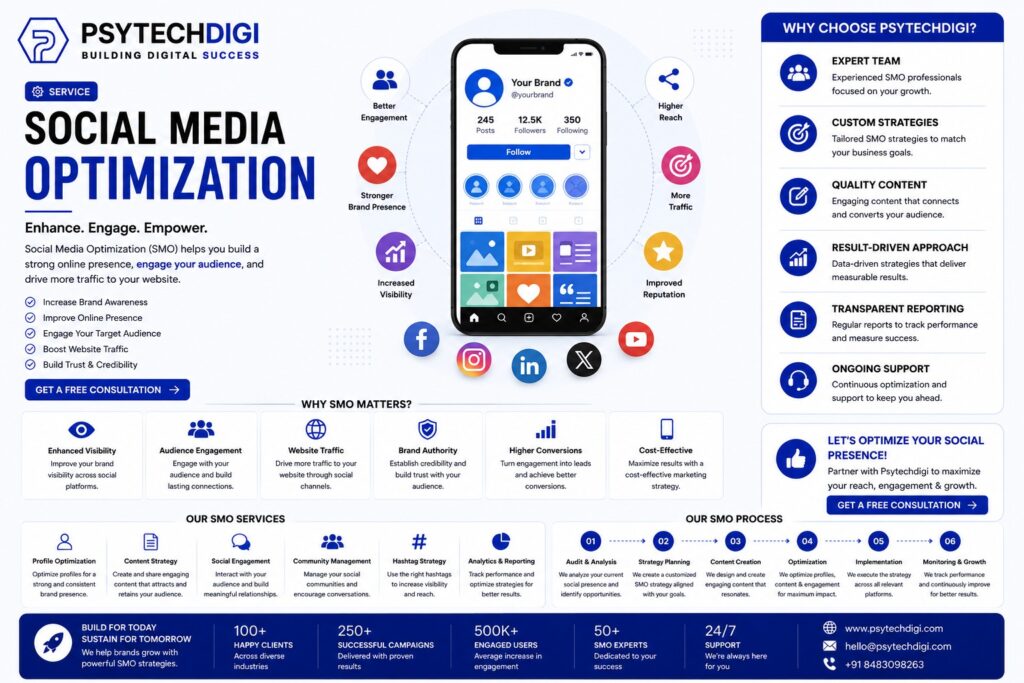
Social Media Optimization Services for Businesses in India
Every business today has social media optimization. Very few have a social media strategy. There is a significant difference between the two, and that gap is precisely where most brands lose ground to competitors who understand what actually drives growth on platforms like Instagram, LinkedIn, Facebook, YouTube, and X. Simply being present — posting sporadically, recycling the same content across channels, and hoping the algorithm will be kind — produces predictable results: flat engagement, stagnant follower counts, and a marketing channel that costs time without returning value.
Social Media Optimization is the structured discipline that closes that gap. It is the process of aligning every element of your brand’s social presence — from how profiles are written, to how content is formatted, to when posts go live, to how the account engages with its community — with what each platform’s algorithm is designed to reward. This guide explains what that process involves, what the evidence shows about its impact, and how Psytech Digi Pvt Ltd delivers it for businesses at every stage of growth.
Why Posting Alone Never Produces Consistent Growth
One of the most common frustrations business owners express about social media is that they are putting in the effort — writing posts, creating graphics, maintaining a schedule — but seeing very little return. The answer to why almost always traces back to the same root cause: content is being created without the structural foundation that Social Media Optimization provides. No amount of effort at the content production level compensates for weak profile signals, poor format choices, or disengaged posting behaviour.
How Algorithms Evaluate Your Account
Every major social media platform operates an algorithmic distribution system that decides how widely to show each piece of content. The algorithm does not evaluate content in isolation — it evaluates the account behind it. It looks at how consistently the account posts, how quickly the audience engages when a new post goes live, whether the account itself engages with others, and whether the profile is complete and clearly categorised. An account that scores poorly on these signals will see its content suppressed regardless of quality.
Understanding this is the first step toward changing it. Algorithm suppression is not arbitrary — it is a direct response to specific, measurable account behaviours. That means it is fixable, and fixing it produces compound results: better distribution means more engagement, more engagement improves the algorithm signal, and improved signals produce better distribution in a self-reinforcing cycle.
The Metrics That Actually Indicate Business Impact
Most businesses track the wrong performance indicators. Follower count and total likes feel meaningful but tell you almost nothing about whether social media is contributing to business outcomes. The metrics that matter are different: reach among people who do not yet follow the account, profile visits from non-followers, click-throughs to the website, saves and shares as indicators of content value, and direct message volume as an indicator of purchase intent. Optimizing for these metrics produces a social channel that contributes to revenue. Optimizing for likes produces a social channel that feels busy but does not grow the business.
Profile Optimization: Building a Foundation for Discoverability
Before a single piece of content is created, the profile itself determines whether the brand is discoverable by the right people. Social media profiles function as both a first impression for human visitors and a structured data input for the platform’s algorithm. Incomplete profiles send a signal of low authority. Profiles optimized with the right keywords, clear visual identity, and fully populated fields send the opposite signal.
What a Fully Optimized Profile Looks Like
Visual identity and brand consistency
Profile images should be high resolution, immediately recognizable, and consistent across every platform the brand occupies. For most businesses, this means a clean logo presentation on a simple background. Cover images and banners — available on LinkedIn, Facebook, and YouTube — represent valuable visual real estate that most brands either leave blank or populate with generic imagery. A cover image that communicates the brand’s core service and audience in a single glance materially improves the rate at which profile visitors become followers.
Bio and headline keyword strategy
The text in a bio, headline, and about section is indexed by the platform’s internal search engine and by Google. Writing these sections with deliberate inclusion of the terms your target audience actually searches for — specific service names, industry language, and location where relevant — dramatically increases how often the profile surfaces in search results. A LinkedIn company page bio that names specific services and includes a city or region consistently outperforms one written as a general description of the company’s history or values. Every word in the bio is a discoverability decision.
Contact fields, categories, and links
All available profile fields should be completed accurately and consistently. Business category selection, contact buttons, website URL, physical address where applicable, and operating hours all contribute to the profile completeness scores that platforms use as quality filters. Leaving these fields empty is the equivalent of removing half your shop front signage. It costs nothing to complete them and materially improves both human trust signals and algorithmic authority scores.
Content Strategy: Turning Effort Into Compounding Results
Content is the most visible expression of a brand’s social media presence, but its performance is almost entirely determined by the strategy behind it. Posting without a clear content strategy produces activity without momentum. A properly designed content strategy—one that is part of a broader Social Media Optimization programme — defines what topics the brand will own, which formats will be used on which platforms, at what frequency, and calibrated to specific audience behaviors and business objectives.
Content Pillars and Editorial Consistency
Content pillars are the three to five recurring themes that define a brand’s social identity. They ensure the content calendar reflects a coherent perspective rather than a random collection of posts. For a professional services business, pillars might include client results, educational insights on core service topics, team and culture content, and industry commentary with a defined point of view. Every piece of content maps to one of these pillars, ensuring that over time, the audience associates the brand with a specific, valuable area of expertise.
Format selection and platform conventions
Each platform has a content format that its algorithm currently rewards above all others, and this changes over time. In 2025, Instagram Reels generate significantly higher organic reach than static posts for accounts that are growing. LinkedIn native document carousels and long-form text posts outperform external link shares. YouTube rewards watch time above nearly every other signal. Using the format that the platform is currently amplifying — rather than defaulting to whatever is easiest to produce — is one of the highest-leverage decisions in any content strategy.
Posting frequency and schedule discipline
Algorithm favour is partly a function of consistency. A brand that publishes three times per week, every week for six months, builds a structurally stronger distribution signal than one that publishes fifteen times in a burst and then disappears for three weeks. The algorithm interprets consistent posting as a high-quality, reliable source and sustains its distribution accordingly. Editorial calendars should be built around frequencies that can be maintained indefinitely — not aspirational targets that collapse under operational pressure.
Social Media Optimization Tactics That Compound Over Time
The most durable gains from Social Media Optimization come not from single interventions but from the accumulation of small, deliberate improvements applied consistently. Hashtag strategy, community engagement behaviour, posting timing, and A/B testing of content formats are individually modest contributors to performance—but compounded across months and years they produce a fundamentally different level of social media effectiveness than accounts that ignore them.
Hashtag and Keyword Research
Hashtags and in-content keywords remain meaningful ranking signals on Instagram, TikTok, YouTube, and LinkedIn. The quality of hashtag selection matters far more than volume. Thirty generic, high-competition hashtags on every post is a weaker strategy than eight to twelve highly specific tags that precisely match the content of the post and the search behaviour of the target audience. Hashtag research should be treated as an ongoing discipline, refreshed regularly as platform trends and audience behaviours shift.
Engagement Behaviour as an Algorithmic Input
Most brands treat social media as an outbound broadcast channel. The platforms reward something more reciprocal. Response time to comments and direct messages, the quality of those responses, and an account’s own engagement with relevant content in its industry niche are all tracked as quality signals. Platforms amplify accounts that create genuine two-way conversation because they drive the on-platform time metrics the platforms are commercially dependent on. A brand that engages actively with its community in the two hours following each post will consistently outperform one that does not, all else being equal.
Timing posts to audience activity windows
Publishing when the target audience is most active on the platform significantly increases the engagement rate in the first hour after posting — the window in which the algorithm makes its initial distribution decision. Platform analytics tools surface the specific hours when a given account’s followers are online. Scheduling to those windows is a simple, zero-cost optimization that produces consistently better initial reach.
A/B testing for systematic improvement
Structured testing — comparing two versions of a post with different headlines, different opening lines, different image choices, or different calls to action — is the most reliable way to build genuine understanding of what resonates with a specific audience. Over time, the insights accumulated through disciplined testing produce a content playbook that consistently outperforms content created on instinct alone. Testing does not require sophisticated tools; it requires consistent methodology and honest analysis of the results.
How Psytech Digi Pvt. Ltd. Builds Your Social Media Presence
Psytech Digi Pvt Ltd is a digital marketing agency headquartered in Pune, with active client engagements across India, the United Kingdom, Australia, and Indonesia. The team delivers a comprehensive social media service that combines strategic planning, creative production, and rigorous performance analysis to produce measurable improvements in social presence and business outcomes.
Our Social Media Optimization Process
Phase 1 — Audit and competitive benchmark
Phase 2 — Profile rebuild and keyword optimization
Phase 3 — Content strategy and editorial calendar
Phase 4 — Content production and scheduling
Phase 5 — Community management and reputation monitoring
Phase 6 — Monthly analytics and strategy iteration
Outcomes Clients Report
Clients who work with Psytech Digi on social media consistently describe three outcomes: a professional, consistent presence across every platform they occupy; measurably higher engagement compared to what they achieved managing accounts in-house; and a team that communicates proactively and delivers on schedule. For businesses that have found social media difficult to manage with internal resources, the agency’s structured approach removes the burden while producing better performance.
Client testimonials from international engagements in the UK, Australia, and Indonesia highlight communication quality, delivery reliability, and genuine care for client outcomes as distinguishing characteristics of working with the team.
Every Day Without Optimization Is a Day Your Competitors Use
Social media platforms will not become less competitive. The brands building strong, well-structured presences today are accumulating algorithmic trust, audience relationships, and brand recognition that will be progressively harder for later entrants to match. The window for building a meaningful organic presence is not closing — but it is narrowing, and the cost of building it increases as markets become more crowded.
Social Media Optimization is what separates accounts that grow from those that plateau. It is the structured, data-driven, consistently executed discipline of making every element of your social presence as effective as it can be — and then iterating based on evidence until the results reflect the investment. When profile quality, content strategy, posting consistency, community engagement, and performance analysis work together as a system, the compounding returns become visible within weeks and substantial within months.
Psytech Digi Pvt Ltd is ready to audit your current social presence, show you precisely where performance is being lost, and build a program to recover and grow it. Reach out today to start the conversation.
What is Social Media Optimization and how is it different from Social Media Marketing?
Social Media Optimization (SMO) is the process of fine-tuning every element of your social presence — profiles, content format, posting schedule, engagement behaviour, and hashtag strategy — so platforms actively amplify your content. Marketing is what you post. Optimization is what makes the platform show it to more people.
Why is my social media not growing even though I post regularly?
Regular posting alone is not enough. Platform algorithms evaluate your entire account — profile completeness, engagement speed after posting, format choices, and how actively you engage with others. Weak signals in any of these areas suppress your content regardless of posting frequency. SMO fixes these structural gaps.
How does Psytech Digi optimize a social media profile?
We rebuild profiles across all platforms — rewriting bios with target keywords, updating profile and cover images to brand standards, completing all contact and category fields, and configuring website links and CTA buttons. A fully optimised profile improves both discoverability in search and algorithmic authority scores.
How long does it take to see results from Social Media Optimization?
Most clients see measurable improvements in engagement and reach within 4 to 6 weeks of profile and content optimisation. Compounding growth — where improved engagement leads to wider algorithm distribution — typically becomes visible within 2 to 3 months of consistent, optimised activity.
Which metrics should I track to know if SMO is working?
Track reach among non-followers, profile visits, click-throughs to your website, saves and shares, and direct message volume. These metrics connect social activity to business outcomes. Follower count and total likes are vanity metrics — they look good but rarely indicate whether social media is generating real business value.